A Pragmatic Analysis of Expressive Speech Acts in Online Comments on Nightbirde’s Audition
Authors
-
 Mulyadi
Universitas Putera Batam, Batam, Indonesia
Mulyadi
Universitas Putera Batam, Batam, Indonesia
-
Afriana
Universitas Putera Batam, Batam, Indonesia
DOI:
https://doi.org/10.30812/humanitatis.v12i2.5321Keywords:
Expressive, Illocutionary Act, Speech ActsAbstract
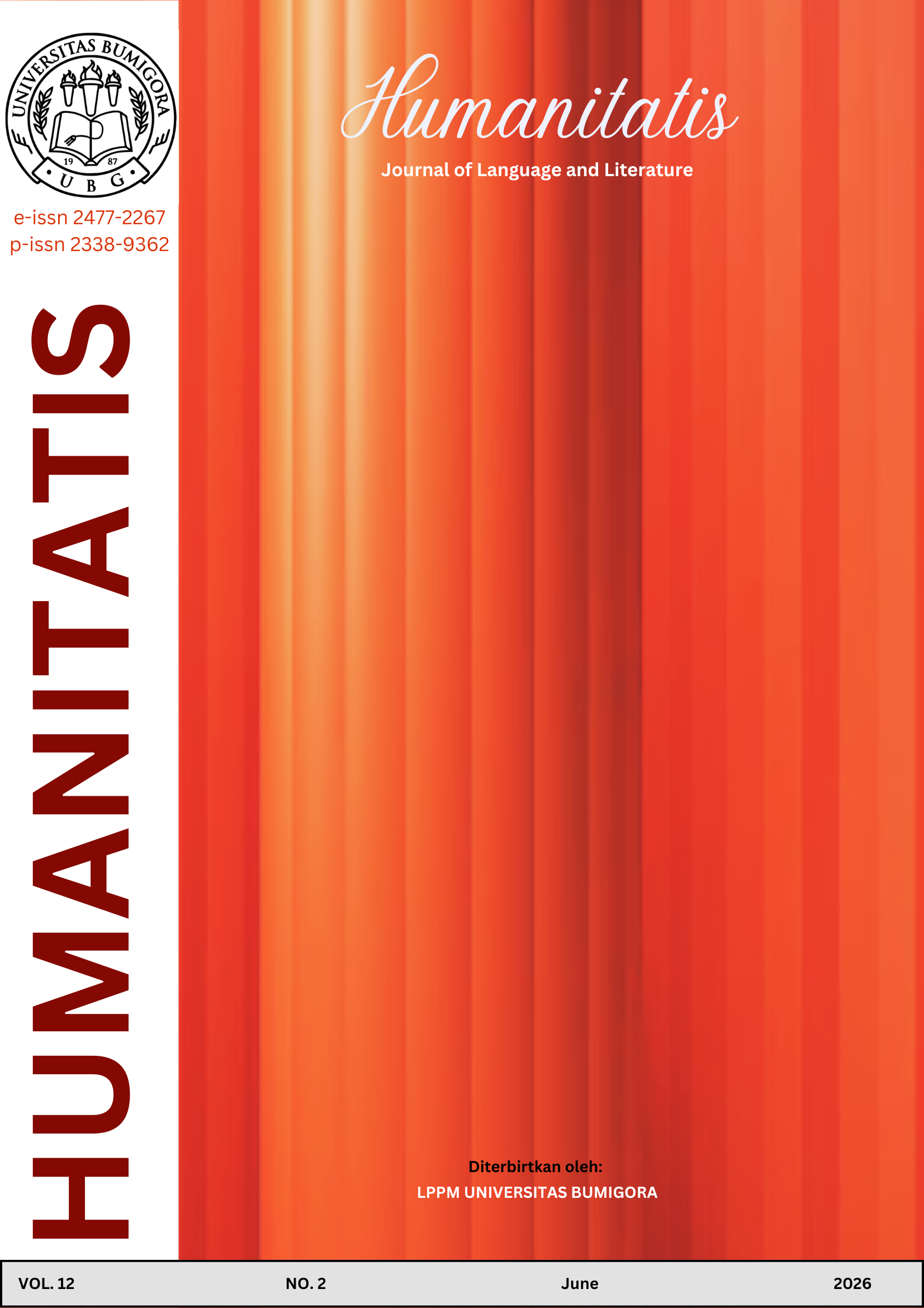
Expressive acts are a major category within illocutionary speech acts. This research aimed to explore and classify expressive speech acts in YouTube comments reacting to Nightbirde’s audition on America’s Got Talent. The analysis is grounded in the expressive speech act theory proposed by Searle and Vanderveken (2009). This research employs a qualitative descriptive method to analyze the data. Data were collected through non-participatory observation and note-taking. From 38 individual comments, 60 data points were identified. The analysis revealed four expressive speech act types: compliment (25 times), thank (13 times), condole (14 times), and lament (8 times). Other types, such as apologize, boast, congratulate, protest, complain, greet, welcome, and deplore, did not appear in the dataset. These results suggest that digital platforms like YouTube foster emotionally expressive discourse, especially in moments of shared mourning. The researcher encourages further exploration of expressive speech acts in varied online contexts, including multimodal forms such as emojis, visuals, and interactional features.
References
Alfia, N., & Fauziati, E. (2023). Speech Act of Condolence to Queen Elizabeth’s Death. https://eprints.ums.ac.id/112374/
Amani, A. S., & Setiarini, N. L. P. (2023). Expressive Illocutionary Speech Acts Used in Queen Charlotte: A Bridgerton Story Series. JEdu: Journal of English Education, 3(3), 230–239. https://doi.org/10.30998/jedu.v3i3.9727
Aritonang, R. O., & Ambalegin, A. (2023a). An Analysis of the Expressive Speech Acts in “Avatar: Way of the Water” Movie. IdeBahasa, 5(1), 47–60. https://doi.org/10.37296/idebahasa.v5i1.115
Aritonang, R. O., & Ambalegin, A. (2023b). An Analysis of the Expressive Speech Acts in “the Willoughbys” Movie. JURNAL BASIS, 10(2), 95–109. https://doi.org/10.33884/basisupb.v10i2.7762
Asia M, Asdar, A., & Lutfin, N. (2024). An Analysis of Expressive Speech Acts in Online Discussion Through Whatsapp Group. RETORIKA: Jurnal Bahasa, Sastra, dan Pengajarannya, 17(1), 1–9. https://doi.org/10.26858/retorika.v17i1.52814
Austin, J. L. (1975). How to Do Things with Words. Clarendon Press.
Creswell, J. W., & Creswell, J. D. (2017, December 12). Research Design: Qualitative, Quantitative, and Mixed Methods Approaches. SAGE Publications.
Dini, D. A., & Rika, R. N. (2023). Analyzing Expressive Speech Acts in Comments on ‘Teacher Welfare Issues in the National Education System Bill’. Jurnal Arbitrer, 10(3), 283–291. https://doi.org/10.25077/ar.10.3.283-291.2023
Eze, C. C., Chukwuezi, E. E., Umelo, N. J. N., & Umeh, I. J. (2024). A Speech Act Analysis of the Language of Protest in 2020 Endsars Protest in Nigeria. Journal of Legal and Cultural Analytics, 3(2), 239–256. https://doi.org/10.55927/jlca.v3i2.10690
Handayani, N. V. (2015). The Use of Expressive Speech Acts in Hannah Montana Session 1. Register Journal, 8(1), 99. https://doi.org/10.18326/rgt.v8i1.99-112
Herawati, S. N., Palupy, F. K., Budiarti, E., Munira, F., & Utomo, A. P. Y. (2022). Analysis of Expressive Speech Acts on the 2017 IPSE YouTube Channel about Panel Discussion of Language Education Course Papers Indonesia IPSE students 2017. Aksis: Jurnal Pendidikan Bahasa dan Sastra Indonesia, 6(2), 118–128. https://doi.org/10.21009/AKSIS.060203
Leech, G. N. (2016, February 17). Principles of Pragmatics. Routledge.
Mareta, D. R., & Afriana, A. (2024). Gender Inequality Analysis Represented in “Little Women” by Louisa May Alcott. INTERACTION: Jurnal Pendidikan Bahasa, 11(1), 67–81. https://e-journal.unimudasorong.ac.id/index.php/interactionjournal/article/view/2297
Martínez, R. A. (2013). Reading the world in Spanglish: Hybrid language practices and ideological contestation in a sixth-grade English language arts classroom. Linguistics and Education, 24(3), 276–288. https://doi.org/10.1016/j.linged.2013.03.007
Mazidah, N. Y. (2019, February 6). Expressive Speech Act Found in EFL Classroom Interaction. http://etheses.uin-malang.ac.id/13473/
Nazrah & Rosida, A. (2024). Analyzing Expressive Speech Acts in The Late Late Show with James Corden. Inspiring: English Education Journal, 7(2), 340–350. https://doi.org/10.35905/inspiring.v7i2.10733
Ngasini, N., Senowarsito, S., & Nugrahani, D. (2021). An Analysis of Expressive Speech Acts Used in Ellen Show "Interview with Billie Eilish". Applied Linguistics, Linguistics, and Literature (ALLURE) Journal, 1(1), 53–62. https://doi.org/10.26877/allure.v1i1.9213
Olenti, N. A., Charlina, C., & Hermandra, H. (2019). Tindak Tutur Ekspresif dalam Twitter. Jurnal Tuah, 1(2), 148–155. https://doi.org/10.31258/jtuah.1.2.p.148-155
Paltridge, B. (2012). Discourse analysis: An introduction (Second edition). Bloomsbury Academic, an imprint of Bloomsbury Publishing. https://doi.org/10.5040/9781350934290
Piscesco, P., & Afriana. (2022). Types of Expressive Acts in Bohemian Rhapsody Movie 2018. English Journal of Indragiri, 6(1), 86–96. https://doi.org/10.32520/eji.v6i1.1819
Putri, J. O. M., & Ariyaningsih, N. N. D. (2023). Expressive Speech Acts Found in Eric Nam and Jessi’s Utterance in the Dive Studios Podcast. Journal of Humanities, Social Science, Public Administration and Management (HUSOCPUMENT), 3(1), 8–14. https://doi.org/10.51715/husocpument.v3i1.258
Putri, L. A. H., Rajistha, I. G. N. A., & Damayanthi, M. S. (2025). The Illocutionary Acts Found in Pearl Movie. Journal of English Language Literary Studies, 1(1), 47–57. https://ejournal.warmadewa.ac.id/index.php/jells/article/view/11399
Rahmawati, R. D. (2021). An Analysis of Expressive Speech Acts Used in Crazy Rich Asian Movie. Journal of Language and Literature, 9(1), 83–94. https://doi.org/10.35760/jll.2021.v9i1.2961
Searle, J. R. (2012). Expression and Meaning: Studies in the Theory of Speech Acts (1. publ). Cambridge Univ. Press. https://doi.org/10.1017/CBO9780511609213
Searle, J. R., & Vanderveken, D. (2009, February 19). Foundations of Illocutionary Logic. Cambridge University Press.
Selviyani, S., & Pujiati, T. (2019). Expressive Speech Act in the Novel Dialogue the Perfect Husband. IDEAS: Journal on English Language Teaching and Learning, Linguistics and Literature, 7(2). https://doi.org/10.24256/ideas.v7i2.1051
Setyaji, A. (2016). How Speech Acts Work in Translation: An Analysis on Speech Acts Translating a Script of Titanic Film. PRASASTI: Journal of Linguistics, 3(1), 14–31. https://doi.org/10.20961/prasasti.v3i1.344
Sudaryanto, S. (2015). Metode dan aneka teknik analisis bahasa. Duta Wacana University Press.
Suryawan, I. N., Yadnya, I. B. P., & Puspani, I. A. M. (2016). Complaint Speech Act Of Hotel And Restaurant Guests. Linguistika: Buletin Ilmiah Program Magister Linguistik Universitas Udayana, 23(44), 44–54. [suspicious link removed]
Tanjung, I. (2021). The Expressive Speech Act in the Lovely Bones Movie. Jurnal Ilmiah Spectral, 7(2), 086–099. https://doi.org/10.47255/51ek4j66
Tauchid, A., & Rukmini, D. (2016). The Performance of Expressive Speech Acts as Found on Wayne Rooney’s Facebook. English Education Journal. https://www.semanticscholar.org/paper/THE-PERFORMANCE-OFEXPRESSIVE-SPEECH-ACTS-AS-FOUND-Tauchid-Rukmini/a9082dfa06a1fc57adf78c101bc1c8b36b4030bb
Vanderveken, D. (2009). Meaning and speech acts. 1: Principles of language use. Cambridge University Press.
Winda, A. W., & Fatmawati, F. (2024). Expressive speech acts in the YouTube Kompas TV comment column based on cyber pragmatics perspective. RETORIKA: Jurnal Ilmu Bahasa, 10(1), 274–284. https://doi.org/10.55637/jr.10.1.9355.274-284
Yule, G. (2010, March 4). The Study of Language. Cambridge University Press.
Yuwono, D. (2014, February 8). Expressive Acts in Barrack Obama’s Presidential Speech in Universitas Indonesia. https://repository.ub.ac.id/id/eprint/100790/
Downloads
Published
Issue
Section
License
Copyright (c) 2026 Mulyadi, Afriana

This work is licensed under a Creative Commons Attribution 4.0 International License.